
Welcome
9:15 – 09:30
The interplay of symbolic dynamics with algebra unfolds in a variety of ways, reflecting the overall richness of the fields. This includes the study of dynamical invariants like dimension groups, associated with the space of invariant measures, or Schützenberger groups, associated with the structure of free profinite semigroups; structural work on automorphism groups of symbolic systems, which also relate to semigroup theory via the construction of Ellis semigroups; relationships with subgroups of the free group, for instance via the theory of codes; cohomological methods linked with cocycles and coboundary, often applied to the study of continuous eigenvalues of symbolic systems; various results exploring the relationship between automatic sequences and power series over finite fields; algebraic methods used in the study of specific systems, like interval exchanges or hypercubic billiards; or the study of symbolic systems, particularly of finite type, over general classes of groups.
Venue: University of Porto, FCUP, Rua do Campo Alegre s/n, 4169-007 Porto
Date: 13.-17 July 2026
Note: Please make sure to complete all the requested information carefully. As indicated in the form, the number of participants is limited due to logistical constraints. Admission to the workshop is reserved due to space limitations.
List of confirmed speakers.
| Name | Affiliation |
|---|---|
| Laurent Bartholdi | Université Claude Bernard Lyon 1 & Institut Camille Jordan |
| Nicolas Bitar | Université de Picardie Jules-Verne |
| André da Cruz Carvalho | Universidade do Porto |
| Julien Cassaigne | Institut de Mathématiques de Luminy |
| Corentin Correia | Institut de Mathématiques de Jussieu |
| María Isabel Cortez | Pontificia Universidad Católica de Chile |
| Fabien Durand | Université de Picardie Jules-Verne |
| Bastian Espinoza | Université de Liège |
| Sébastien Ferenczi | Institut de Mathématiques de Marseille |
| France Gheeraert | Université Picardie Jules-Verne |
| Jarkko Kari | University of Turku |
| Toghrul Karimov | Max Planck Institute for Software Systems |
| Thierry Coulbois | Institut des Mathématiques de Marseille (I2M) |
| Bryna Kra | Northwestern University |
| Maria Pires de Carvalho | Universidade do Porto |
| Ville Salo | University of Turku |
| Scott Schmieding | Penn State University |
| Reem Yassawi | Mary Queen University of London |
| Michael Boyle | University of Maryland |
Program overview.
For a group $G$ acting on a compact metric space, the study of the induced action of $G$ on the space of nonempty compact subsets of $X$ captures topological information of orbits. To capture statistical distribution of orbits, we turn to the study of invariant measures for the induced action. I will give an overview of recent work with Scott Schmieding on the properties of such measures, with applications to particular systems of combinatorial interest.
In this talk we will discuss a language-theoretic approach to study the density of subsets in nonabelian free groups. Concretely, we will show how an infinite monkey theorem-like result allows us to prove that automorphic orbits of elements in free groups have density 0. We will then discuss the case of finitely generated subgroups of positive density, where the situation can be fully understood.
I will discuss spaces of subshifts of full shifts on a finite alphabet over $Z$, and some structures on them. I will also discuss automorphism groups of such shift spaces, and connections with the spaces of subshifts. The talk will not focus on any particular result, but survey various ideas and mention several questions.
A Pisot numeration system $U$ for $N$ is a sequence of natural numbers generated by an integral homogeneous linear recurrence whose characteristic polynomial is the minimal polynomial of a Pisot number. In this talk we introduce the analogue of the group of $p$-adic integers for such numerations when they preserve zeros, which is equivalent to the “Condition F” introduced by Frougny and Solomyak for $\beta$-numerations. We show that these topological groups $Z_U$ project homomorphically onto a torus. Equipping $Z_U$ with the appropriate topology, we also show that if $U$ is unimodular, then $Z_U$ is continuously isomorphic to a torus. Time permitting, I will discuss how this can be applied to show that some substitution dynamical systems possess independence sequences, implying that their Ellis semigroup is nontame, i.e., has cardinality $2^{|\mathbb{R}|}$. This is joint work with Olivier Carton and Jake Sudbery.
I will try to compare, underline the common ground and propose correspondances and
translations between the Parageometric Outer automorphisms of Free Groups and Dendric Substituions.
Two countries: From a finite alphabet $A$, as a group theorist I allow inverses and consider the free
group $F_A$ of reduced words on $A^{\pm 1}$ and its automorphisms. In the neighbooring country, a substitution
replaces each letter by a finite word and extends to $σ:$ $A∗→A∗$. Those two countries are not very far
apart: Inverses and non-reduced words are domesticated for automorphisms of free groups through
the Cooper Cancellation Bound and Bestvina-Handel Train-Tracks.
There is a zoology of automorphisms of free groups (geometric, iwip, atoroidal, etc.). We focus on
Fully irreducible parageometric Outer automorphisms of free groups. With Milton MINERVINO we
constructed a tree substitutions for them. This is a way to produce nice pictures and visualize the
dendric property.
This talk deals with the correspondance:
- lamination vs shift
- singular leaves vs asymptotic pairs
- repelling tree vs Rauzy fractal
A group is self-simulable if all its computable actions on Cantor space admit SFT covers. We prove that a graph product of infinite finitely-generated groups is self-simulable if and only if its defining graph has no disconnecting clique consisting of amenable groups. In particular, a right- angled Artin group (a.k.a. a graph group) is self-simulable if and only if the defining graph has no disconnecting clique. This has the purely group-theoretic consequence that a graph product of infinite groups splits over an amenable subgroup if and only if it has a clique of amenable subgroups. Since our deduction is purely in terms of the coarse geometry of the group, we obtain that the property of splitting over amenable subgroups is a quasi-isometry invariant among graph products of infinite finitely-presented groups.
Certain Wang tile sets encode arithmetic constraints that rule out periodic tilings. Examples are the classical 16-tile set and the 24-tile set derived from Ammann and Penrose geometric tiles. In these sets one can decorate the tiles with horizontal and vertical bars so that, in any valid tiling, the bars join to form bi-infinite stripes across the plane. The arithmetic constraints are such that these stripes are forced to have irrational densities. In the Amman and Penrose cases the stripe densities are equal to the inverse of the golden ratio. We generalize the construction and show how, for any integral quadratic equation with an irrational solution between 0 and 1, one can construct an aperiodic Wang tile set that admits only tilings with the stripe density equal to a solution of that equation. This is a joint work with Sébastien Labbé and Pieter Mostert.
$S$-adic subshifts can be encoded, via their directive sequence, using omega-regular languages.
This is an example of ”automatic presentation” of structures: an omega-regular language $L$
and relations on $L^{ni}$ that encode the operations of the structure. One immediate application is that
all the first order theory of the structure (which sentences are true) is decidable. The game is thus to
find as many operations as possible that admit omega-regular encodings.
I will show that equality of S-adic words, translating, determining if two sequences are in the same
translation orbit, desubstituting, estimating the distance, etc. may all be added to the first order language under consideration.
The most important operation, ”multi-orbit” (given a 2$k$-tuple of elements
$(x_1,...,x_k ,y_1,...,y_k )$ of the shift space, can every $x_i$ be shifted by the same amount into $y_i$?) may also be added.
As a consequence, we obtain an algorithmic way of testing whether the Pisot conjecture holds for a substitutive subshift.
This is joint work with Ivan Mitrofanov.
We will discuss a novel method for establishing (un)decidability of logical theories that is based on ideas from ergodic theory and Diophantine approximation. Let $(u_n)_{n\in\mathbb{N}}$ be a non-degenerate linear recurrence of order two with two non-real roots, e.g. $u_{n+2} = 4u_{n+1} - 5u_n$. Then $(u_n)_{n\in\mathbb{N}}$ defines, in a specific computational sense, all finite sequences over non-negative integers $\mathbb{N}$, and consequently the first-order theories of $\langle \mathbb{N};
Eighteen years after the introduction of the Domino Problem, Myers proposed a new type of tiling problem: Domino Snake Problems. Among these, the Infinite Snake Problem asks, given a set of Wang tiles, if there exists a well-tiled bi-infinite injective path. This problem was shown to be undecidable by Adleman, J.~Kari, L.~Kari, and Reishus, who showed a reduction from the Domino Problem using tiles that recreate Hilbert’s space-filling curve. After the introduction of the Infinite Snake Problem for groups, this presentation aims to find a generalization of Adleman et al.’s proof of the undecidability of the infinite snake problem on $\mathbb{Z}^2$. We will introduce the notion of a space-filling subshift; a subshift that codes arbitrarily large portions of a space-filling curve on the group on which it is defined. We will explore their properties, when we can define them through local rules, and show new examples. Joint work with Sebastián Barbieri.
A rich family of symbolic dynamical systems of low complexity is given by automatic sequences. These sequences are obtained by feeding the base-k expansions of integers, for a fixed integer base k, into a finite automaton. In this talk, we turn to automatic sequences in rational bases, using as a guiding example a rational-base analogue of one of the most classical integer-base automatic words. Namely, we consider the Thue–Morse word in base 3/2, whose n-th term is given by the sum modulo 2 of the digits in the base-3/2 representation of n. Our results show that, although this base-3/2 variant is substantially more complex than classical automatic words (for instance, it is not generated by iterating a single substitution, and its factor complexity grows superlinearly) it nevertheless retains several characteristic properties of the integer-automatic world. More precisely, we prove uniform recurrence, establish the existence of letter frequencies, and show several combinatorial symmetries of its language. Our approach relies on describing the word via the periodic iteration of two substitutions, studying the induced action of these substitutions on the 2-adic integers, and applying Pontryagin duality on this group. This is joint work with Julien Cassaigne, Michel Rigo, and Manon Stipulanti.
Return words were introduced in the late 90’s as a mean to build well-behaved S-adic representations. They are defined as the words appearing between two consecutive occurrences of a common word. Return words have since been shown to be closely related to other combinatorial notions. For example, their number can be used to characterise Sturmian shifts, or more generally, their algebraic properties characterise dendric shifts. I will survey some of the combinatorial and algebraic aspects of return words, including results obtained with H. Goulet-Ouellet, J. Leroy and P. Stas.
In the light of recent developments in the study of low complexity subshifts we revisit, within the framework of S-adic representations, a well-known result on Toeplitz subshifts due to Jacobs–Keane giving a sufficient combinatorial condition to ensure discrete spectrum and the so-called Pisot conjecture for substitutions.
For a residually finite group $G$, we establish a bijective correspondence between Toeplitz subshifts $X \subseteq \{0,1\}^G$ and model sets defined by a particular class of windows in odometers. This correspondence allows us to obtain realization theorems for the rank and for the number of ergodic invariant measures of Toeplitz subshifts on groups. This is joint work with Jamal Drewlo, Jaime Gómez, and Tobias Jäger.
Two measurable bijections of a standard probability space are orbit equivalent if they
have the same orbits up to conjugacy. In recent years, odometers have been a central class of systems
for explicit constructions of orbit equivalences, using their combinatorial structure.
In this talk we introduce a construction of orbit equivalence between odometers and new systems that
we call odomutants. The starting point for this notion is a construction of Feldman in 1976, which
enables us to get a first flexibility result about even Kakutani equivalence.
Here we deal with a second result, about entropy. It follows from work of Kerr and Li that if the
cocycles are log integrable, the entropy is preserved. Our construction of odomutants shows that their
result is optimal, namely we find odomutants of positive entropy orbit equivalent to an odometer, with
almost log integrable cocycles.
I will also talk about odomutants from a topological viewpoint, since a more topological version is
hidden behind the statement about entropy, dealing with strong orbit equivalence.
I will present joint work with Udayan Darji (University of Louisville, USA) and Paulo Varandas (University of Aveiro, Portugal, and Federal University of Bahia, Brazil), where we establish a new framework for symbolic dynamics. More precisely, we introduce a new family of linear bounded operators on Banach spaces, which we call shift operators, that comprises weighted shifts and, up to linear conjugation, finite products of weighted shifts. I will illustrate the variety of dynamical properties shift operators exhibit and explain how we classify a large class of these operators.
We investigate the class of Bruin–Troubetzkoy interval translation mappings, viewed as S-adic systems generated by an explicit family of substitutions. We show that a typical member of this class is weakly mixing, then construct the first examples of non weakly mixing ITM of infinite type. This is a joint work with M. Artigiani, A. Avila, P. Hubert, A. Skripchenko.
Many families of infinite words (or of subshifts) have a subword complexity function $p(n)$ that grows linearly. It sometimes has a very simple form (such as $n+1$, $2n+1$, etc.), but often exhibits more complicated behaviour, as in the case of the Thue–Morse word. In his Ph.D.\ thesis, Alex Heinis introduced the set $\Omega$ of pairs $(\alpha,\beta)$ such that $\alpha = \liminf p(n)/n$ and $\beta = \limsup p(n)/n$ for some infinite word. For instance, the Thue–Morse word gives the point $(3, 10/3)$. But not every point with $\alpha \le \beta$ can be obtained, and it is a challenge to characterize the points in $\Omega$. We present some properties of this set, and some questions that we find interesting.
Flow equivalence is a classical equivalence relation on self-homeomorphisms of compact metric spaces: $S$ and $T$ are flow equivalent when they are cross sections to a common flow. In the case that $S$ and $T$ are shifts of finite type, defined by square nonnegative integral matrices $A$ and $B$, we show that shift equivalence of $A$ and $B$ implies flow equivalence of $S$ and $T$ (this was well known in the case $A$ and $B$ are irreducible). For shifts of finite type, shift equivalence of $A$ and $B$ is equivalent to eventual conjugacy of $S$ and $T$ (i.e., $S^n$ is topologically conjugate to $T^n$ for all but finitely many $n$). I have no example of eventually conjugate subshifts which are not flow equivalent. As time permits, I’ll give the main ideas of the proof; explain how topological conjugacy and flow equivalence have a natural common algebraic framework; indicate what a more “natural” proof could look like; and discuss prospects for a generalization to sofic shifts. The title result is a paper on the arXiv, to appear in Illinois J. Math.
The conference will take place at the Mathematics/ Library building FC1, which is to the far left as one enters the campus from the street "Rua do Campo Alegre"
The room 003, on the entrance level, straight ahead past two glass doors, and then just to the right of the stairs going down.
Venue: University of Porto, Rua do Campo Alegre s/n, 4169-007 Porto, Portugal.
Wi-Fi: For guest/ visitor Wi-Fi, please ask the organizers on site to give you the login credentials.
Help:
There are plenty of buses that you can catch to reach FCUP. On Rua do Campo Alegre, there are 3 bus stations where you can get off: Gólgota (to Building FC1 or FC2/FC3); Planetário (Building FC4, FC5 anf FC6) and Casa das Artes (FC6).
For more information, please visit: www.stcp.pt
If you want to get to Porto by train, you should get off in one of two main stations: Campanhã or S. Bento.
If you get off at Campanhã, there are 2 means of public transport available to get to FCUP:
If you get off at S. Bento, you can also get to FCUP with 2 possible options:
For more information, please visit: www.cp.pt
FCUP is located in Pole 3 of the University of Porto (Polo Campo Algere)
If coming from North or East, you should follow the main collector road of VCI, towards Lisbon (Ponte da Arrábida) and exit in Campo Alegre.
If coming from South, follow the direction towards Ponte de Arrábida and exit in Campo Alegre (1st exit immediately after the bridge).
The conference hotel is Hotel da Bolsa, located at Rua de Ferreira Borges 101, 4050-253 Porto
The banquet will take place on Wednesday evening at 20h at Restaurant BH Foz, located at Av. do Brasil 498, 4150-025 Porto.
A short look back at a week of ideas, discussions and collaborations.
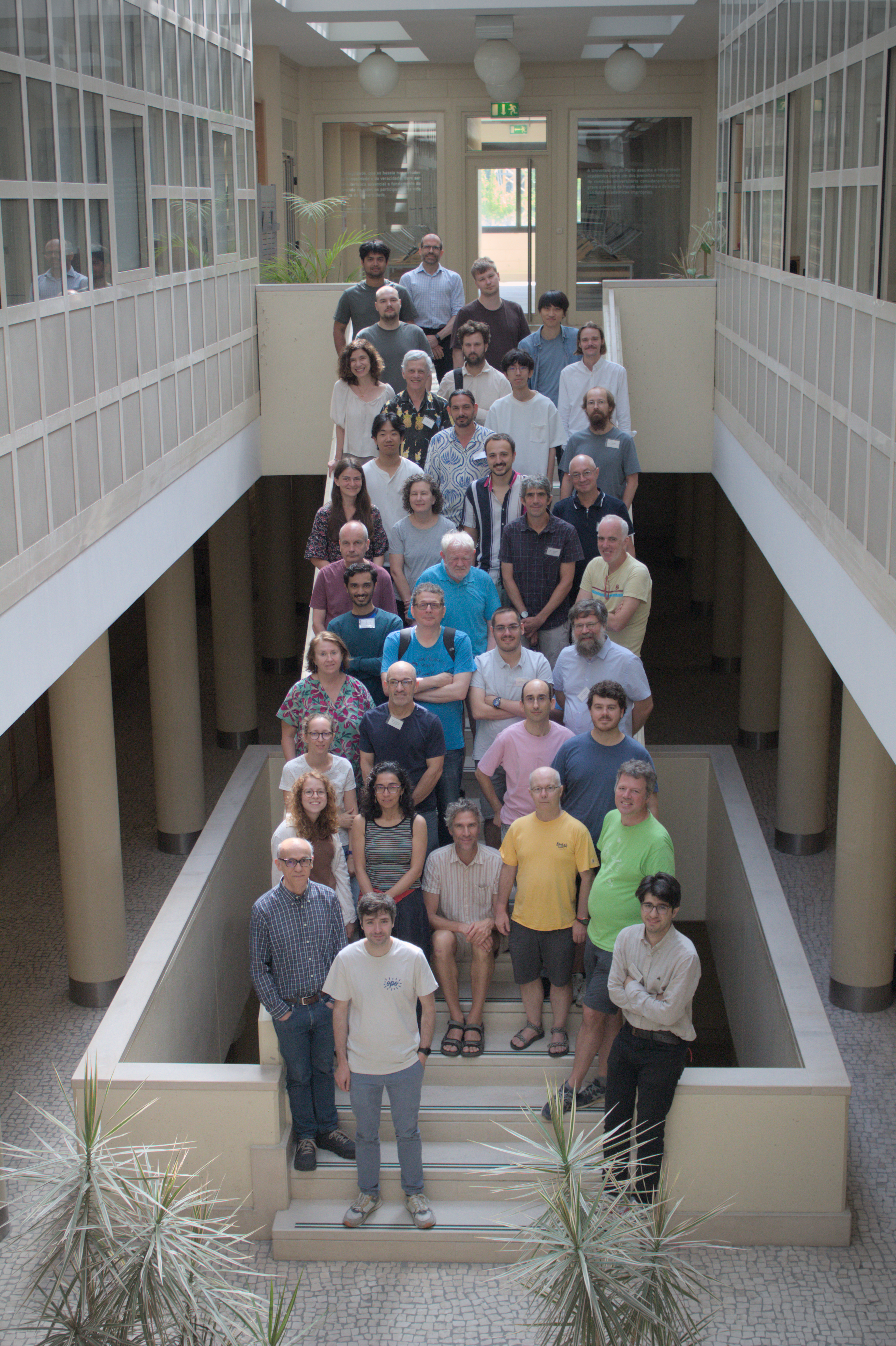
From 13–17 July 2026, researchers from around the world gathered for a week of presentations, discussions and collaborative work across symbolic dynamics and algebra.
The workshop brought together researchers from a wide range of backgrounds to discuss recent advances at the interface between symbolic dynamics and algebra, opening paths toward future collaborations and new research directions.
The program combined invited talks with generous time for discussions and interaction among senior and early-career researchers.
The organizers thank all participants for their engagement and insightful contributions to the workshop’s success.

The workshop is a sequel to the special workshop held at the TCA Conference in Aveiro in 2024 under the same title, that you can find here .
This workshop is funded by the European Research Council DynAMiCs (ERC Synergy Grant: 101167561)