Quick Facts
Venue: Bellairs Research Institute, Folkestone, St. James, BB24017, Barbados.
Help:
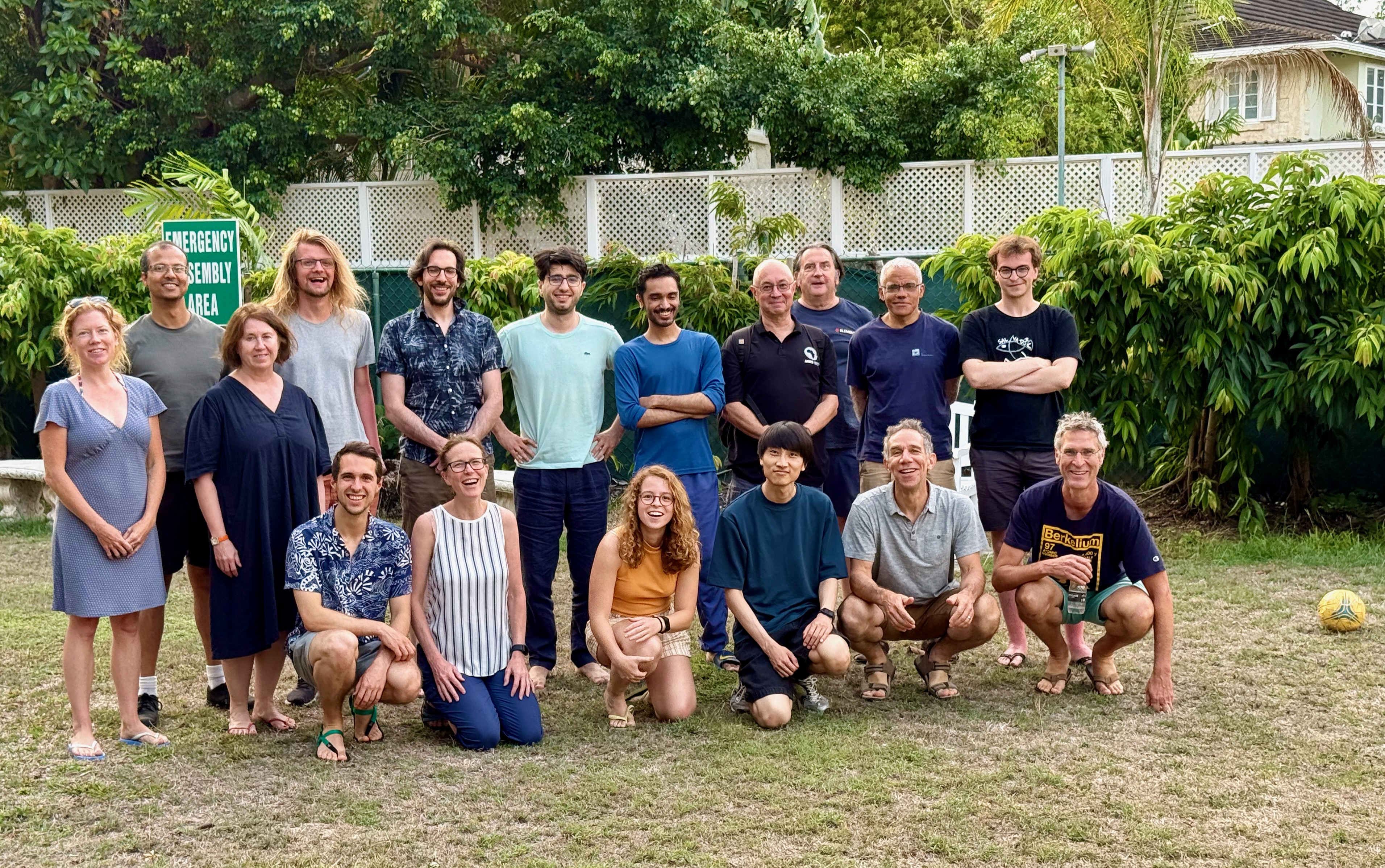
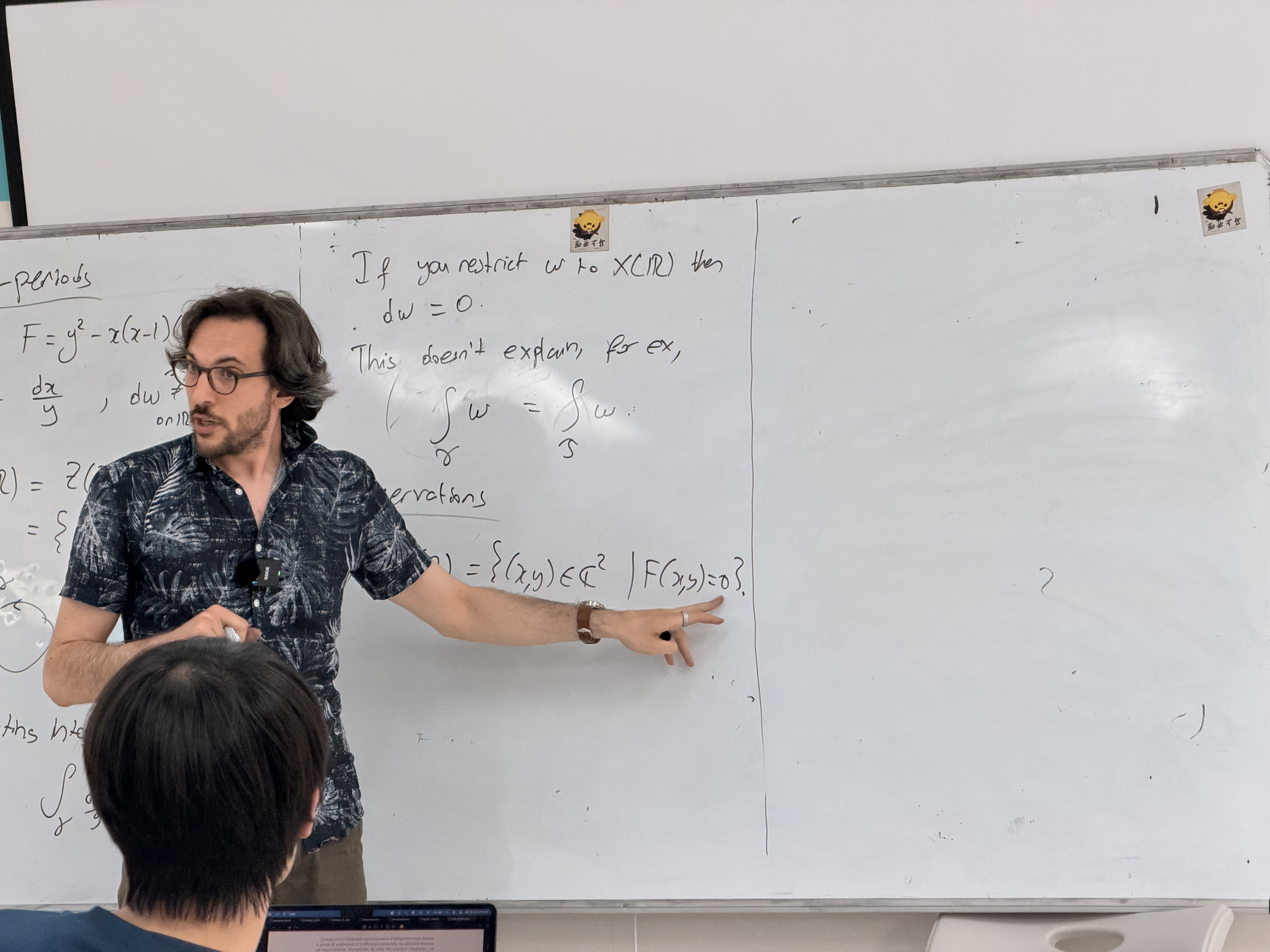
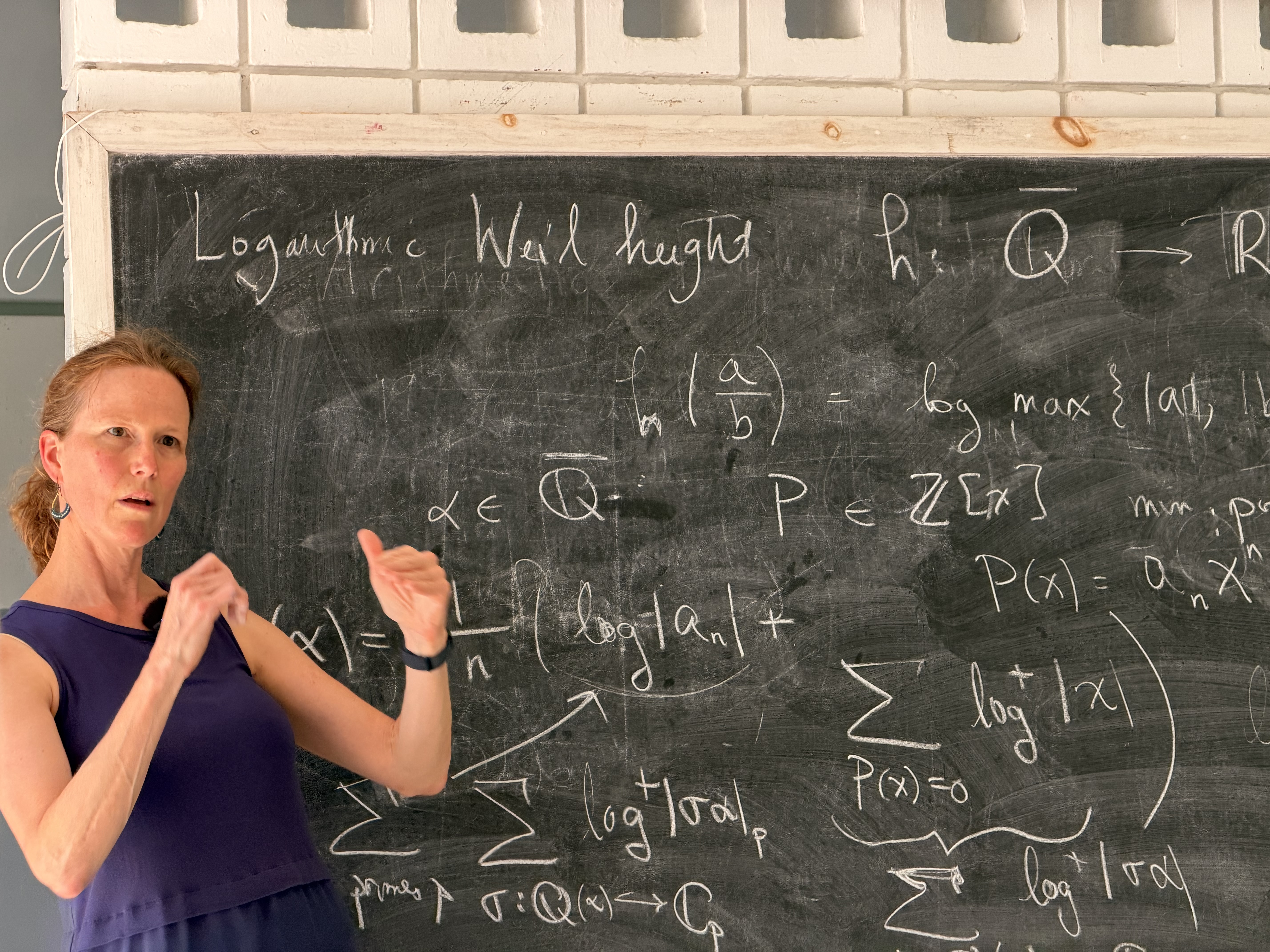
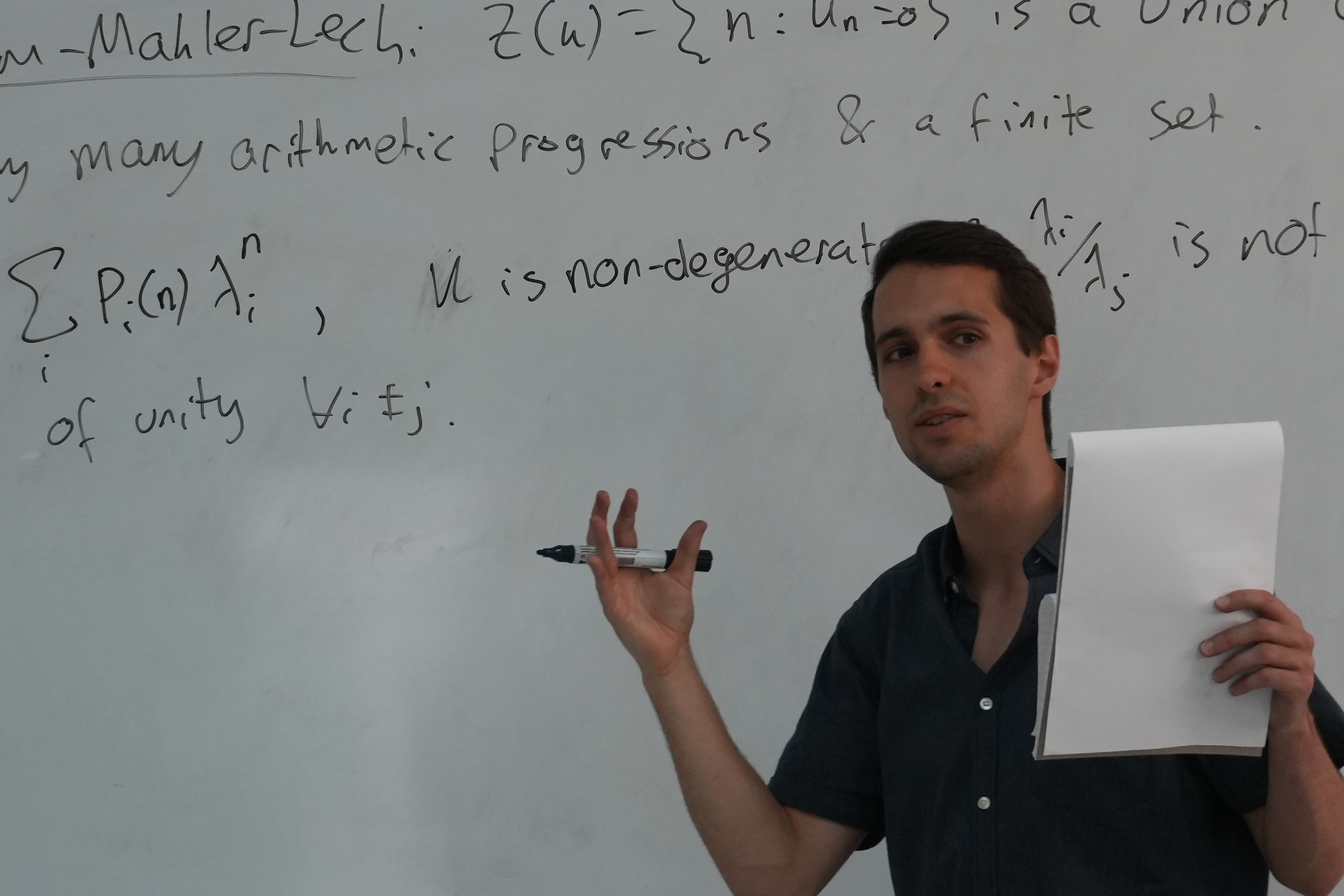
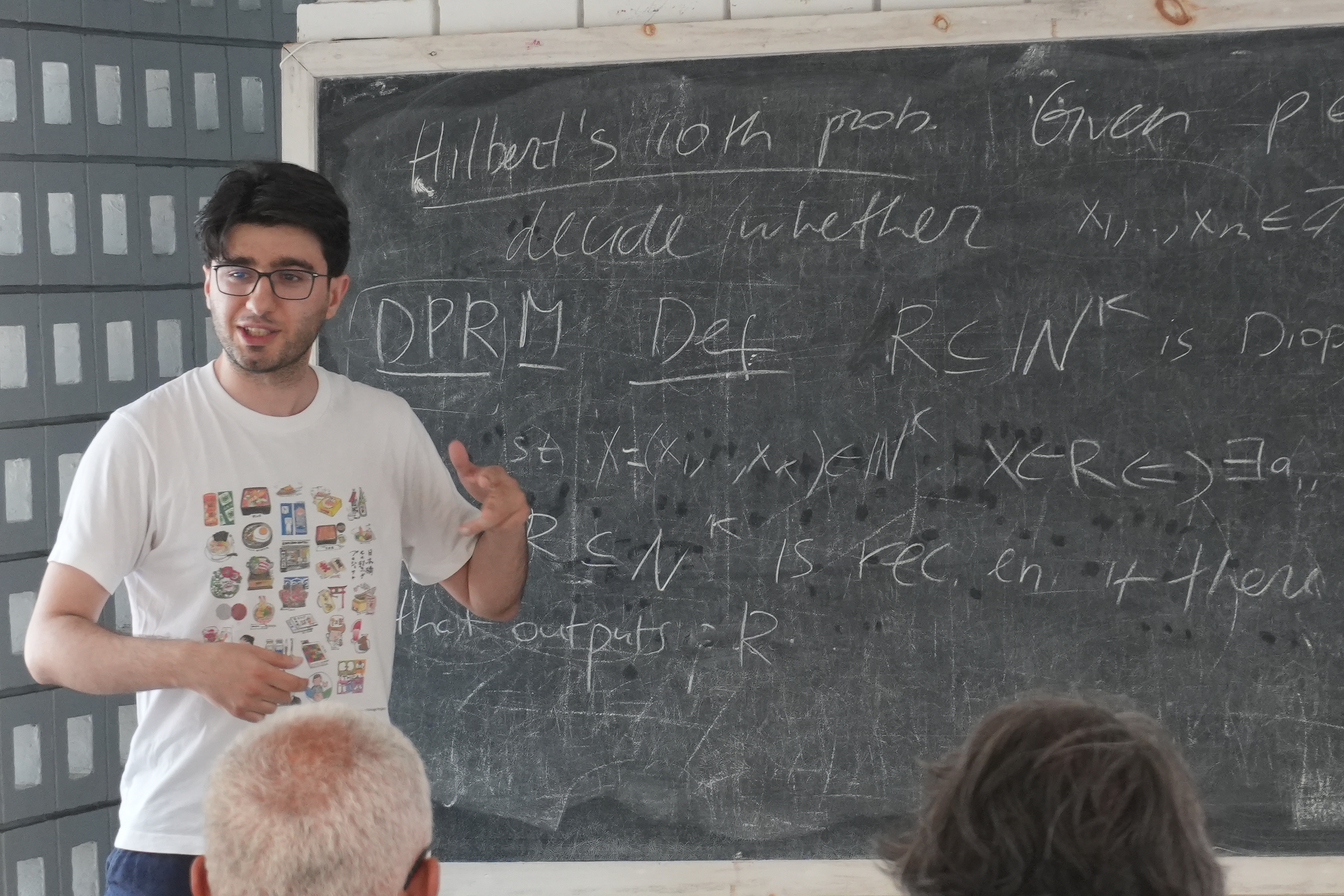
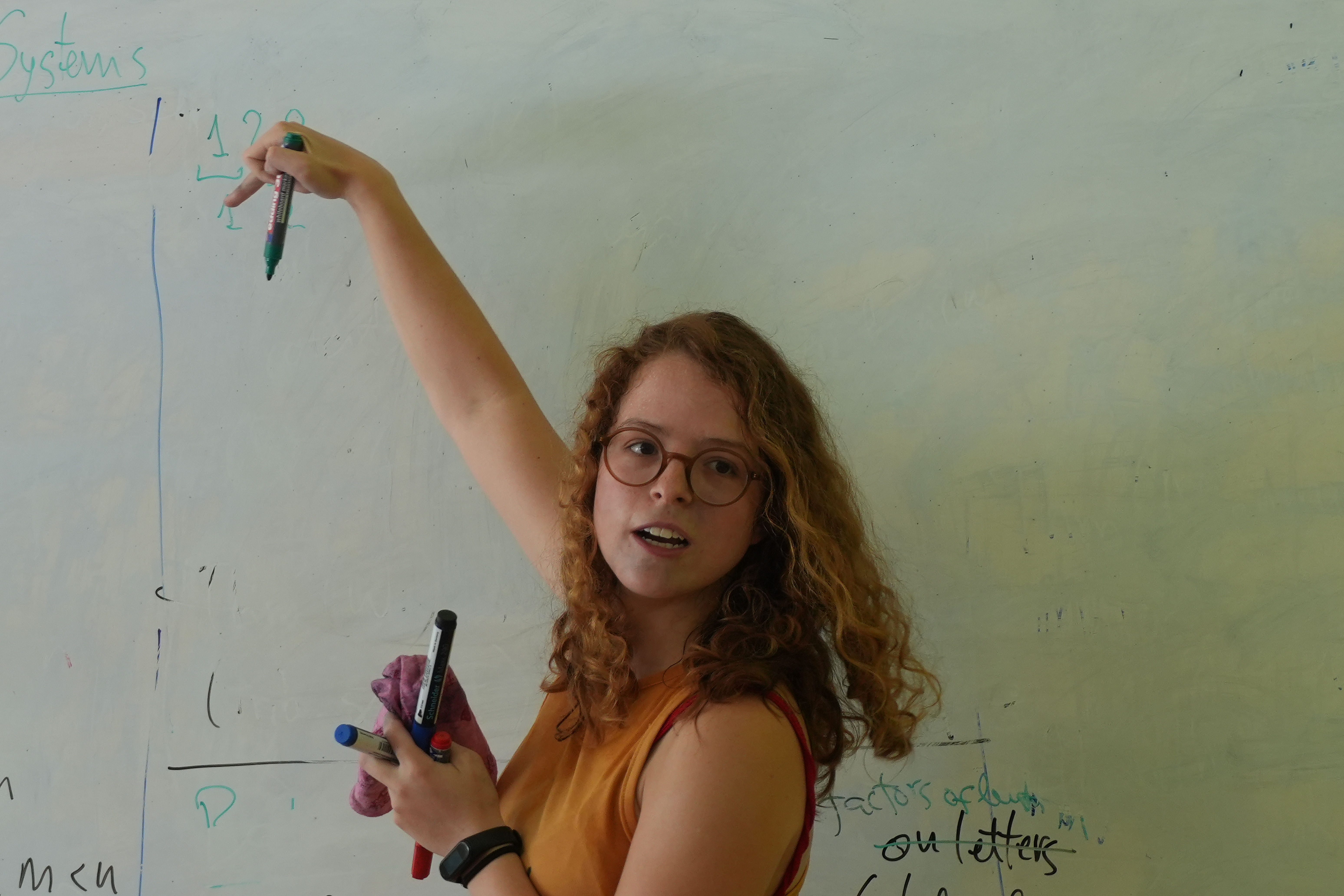
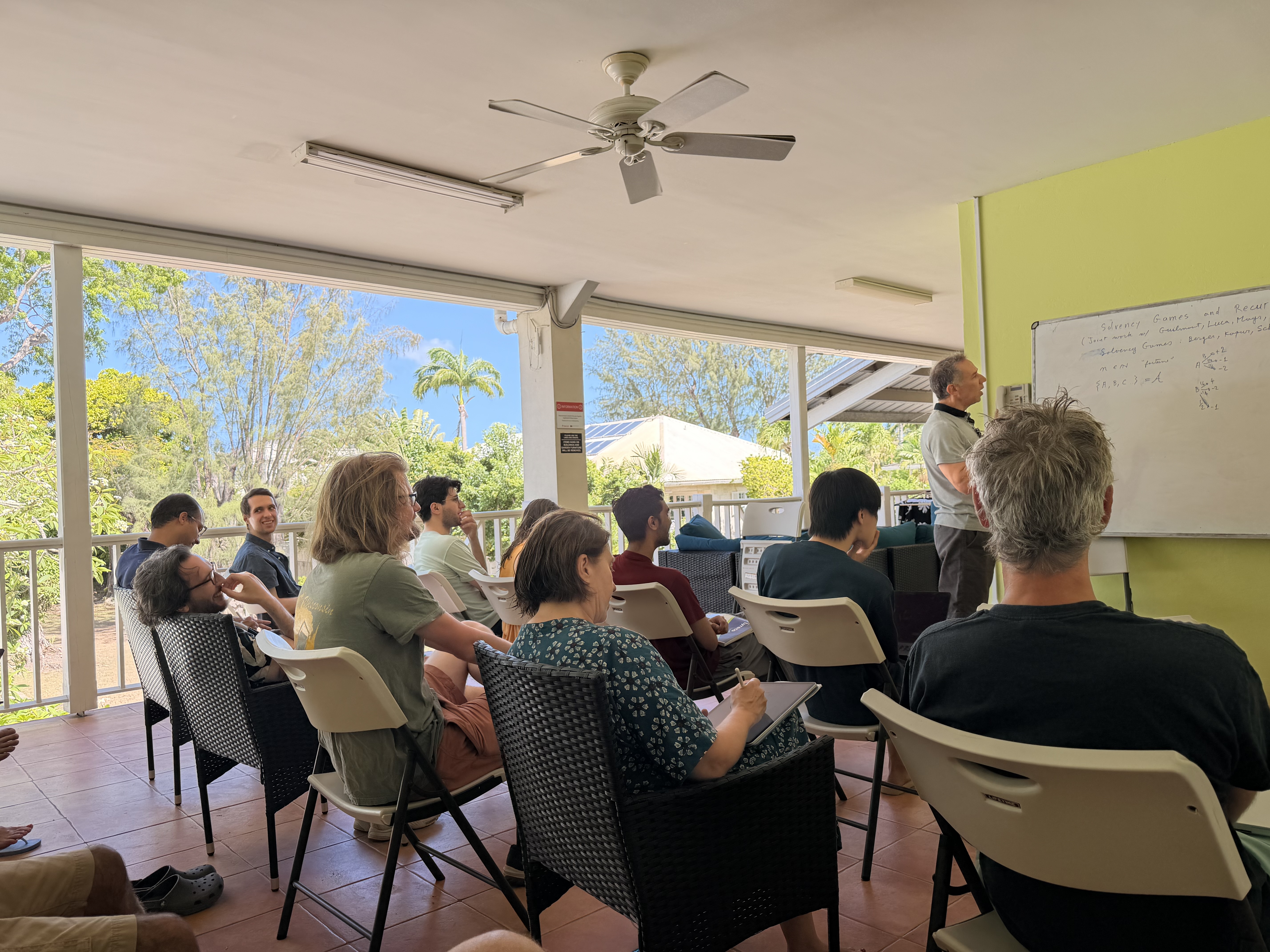
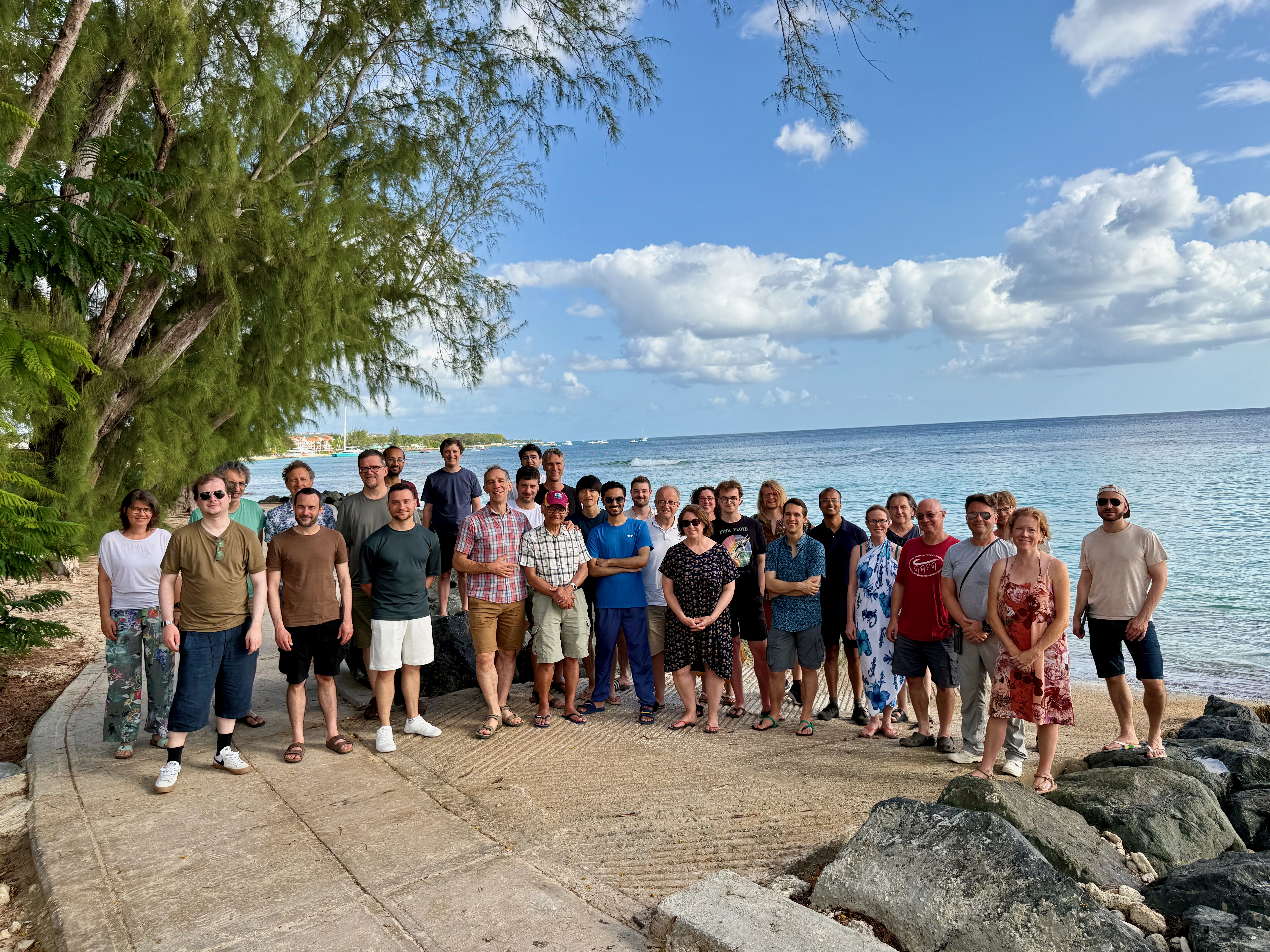
The workshop explores topics in discrete and continuous dynamics at the confluence of computer science (decision problems, invariant generation, complexity, etc.) and mathematics (number theory, Diophantine geometry, arithmetic dynamics, symbolic dynamics, etc.) The workshop is taking place at McGill's Bellairs Research Institute, located directly on a beautiful beach in Barbados. We are planning to give speakers ample time to describe background and get to technical details, and there will be lots of opportunities for extensive discussions. Talks will be given on primitive chalkboards. Therefore, please do not prepare slides for a data projector. There should be lots of opportunities for extensive small group discussions.
Venue: Bellairs Research Institute (McGill University), Folkestone, St. James BB24017 Barbados
Date: 05-12 June 2026
Note: Admission to the workshop is by invitation only.
There will be a parallel workshop on Quantitative Reasoning, organized by Alexandra Silva and Prakash Panangaden.
List of confirmed participants.
| Name | Affiliation |
|---|---|
| Chris Schulz | Department of Pure Mathematics, University of Waterloo |
| Emil Rugaard Wieser | Max Planck Institute for Software Systems |
| Emre Sertöz | Mathematical Institute, Leiden University |
| Faustin Adiceam | Université Paris-Est Créteil |
| Florian Luca | Max Planck Institute for Software Systems |
| Holly Krieger | Department of Pure Mathematics and Mathematical Statistics, University of Cambridge |
| James Worrell | University of Oxford |
| Jihyuk Seo | Institut de Recherche en Informatique Fondamentale |
| Joël Ouaknine | Max Planck Institute for Software Systems |
| Laura DeMarco | Department of Mathematics, Harvard University |
| Laurent Bartholdi | Institut Camille Jordan, CNRS, Université Claude Bernard Lyon 1 |
| Maria Clara Werneck | Institut de Recherche en Informatique Fondamentale |
| Mihir Vahanwala | Max Planck Institute for Software Systems |
| Piotr Bacik | Max Planck Institute for Software Systems | University of Oxford |
| Taieb Oussaifi | Max Planck Institute for Software Systems |
| Tifany Koniezna | Institut de Recherche en Informatique Fondamentale |
| Toghrul Karimov | Max Planck Institute for Software Systems |
| Valérie Bérthé | Institut de Recherche en Informatique Fondamentale |
| Victor Shirandami | Institut de Recherche en Informatique Fondamentale |
Program overview.
| Date | Time / location | Title / author / abstract |
|---|---|---|
| Sunday 07 June 2026 | 09:30–10:30 Picnic Area |
On Pisot dynamics
Valérie Berthé
AbstractA Pisot number is a real algebraic integer whose Galois conjugates are less than 1 in absolute value. In this survey lecture, we present various results inspired by the (substitutive) Pisot conjecture. This conjecture states that Pisot morphisms (i.e., morphisms acting on words whose expansion factor is a Pisot number) are conjectured to generate symbolic codings of the simplest dynamical systems, namely group translations on compact abelian groups, such as e.g. circle translations. |
| 10:00–10:30 Foyer | Coffee break | |
| 11:00–12:00 Pergola |
Preservation Theorems for Transducer Outputs
Mihir Vahanwala
AbstractSuppose we have a deterministic finite-state transducer $A$ and an infinite word $x$, and run $A$ on $x$ to obtain an infinite word $A(x)$. Which properties of $x$ are guaranteed to also hold for $A(x)$? In this talk, we consider this preservation question for various well-known classes of words having desirable combinatorial properties, e.g., recurrent words, primitive morphic words, and words that admit factor frequencies. The celebrated Krohn–Rhodes theorem provides the framework for proving our preservation results, and our techniques are based on the ergodic theory of symbolic dynamical systems, i.e., shift spaces. This talk is based on joint work with Valérie Berthé, Herman Goulet-Ouellet, Toghrul Karimov, and Dominique Perrin. |
|
| 12:00–14:00 — | Lunch break | |
| 14:00–15:30 Picnic Area |
On the linear relations of 2(!)-periods
Emre Sertöz
AbstractThe Grothendieck period conjecture, a version of which was made famous by Kontsevich and Zagier, is something of a fantasy, suggesting that much of transcendental number theory must be subsumed by polynomial algebra over the rationals. Even in the limited cases where this conjecture is known to hold, translating the problem across these two mathematical fields and then solving the underlying algebra problem is highly elaborate. In 2025, with J. Ouaknine (MPI-SWS) and J. Worrell (Oxford), we made this translation algorithmic for $\overline{\mathbb{Q}}$-linear identities between $1$-periods. These are the period integrals of single-variable algebraic functions, of which $\pi$, $\log 2$, and elliptic integrals are the first examples.
|
|
| 15:30–16:00 Foyer | Coffee break | |
| 16:00–17:30 Pergola |
The automatic expansions of Presburger arithmetic
Chris Schulz
AbstractOne topic of study in mathematical logic concerns the first-order theories of the natural numbers with various algebraic structures thereupon. Questions answerable in this topic include which such theories are decidable (i.e. recursive) and what the definable sets and relations are in each theory. We will present an overview of the existing knowledge in this direction as it applies to the specific context of k-automatic structure, which is the structure given by regular properties of the base-k representations of numbers, including previously known results as well as results proven by the speaker and their coauthors. |
|
| Monday 08 June 2026 | 09:30–10:30 Picnic Area |
Around the Danzer Problem and the construction of dense forests
Faustin Adiceam
AbstractA 1965 problem due to Danzer asks whether there exists a set with finite density in Euclidean space (i.e. « not containing too many points ») intersecting any convex body of volume one. A suitable weakening of the volume constraint leads one to the (much more recent) problem of constructing dense forests. Progress towards these problems have so far involved a very wide range of areas in mathematics (including number theory, computer science, ergodic theory, geometry and harmonic analysis). After surveying some of the known results related to the Danzer Problem and to the construction of dense forests, the talk will present some new constructions. |
| 10:00–10:30 Foyer | Coffee break | |
| 11:00–12:00 Pergola |
Arithmetic Equidistribution
Laura DeMarco
AbstractI will provide an introduction to a collection of results known as "arithmetic equidistribution theorems" that describe the geometry of points (in an algebraic variety) with small arithmetic complexity (defined by a notion of height with good properties). I will give simple examples and mention a few fancy versions that have been useful in different settings, with applications to the study of algebraic dynamical systems. Quantitative versions also exist. |
|
| 12:00–14:00 — | Lunch break | |
| 14:00–15:30 Picnic Area |
The Arithmetic of Dynamical Sequences
Holly Krieger
AbstractIn this talk we'll discuss some sequences of rational numbers associated to iteration of algebraic functions. These include well-known sequences such as Fibonacci and other linear recurrence sequences, more rapidly growing sequences arising from orbits of points under iteration of morphisms, and rather mysterious sequences arising as algebraic degrees of iterates of birational maps. I'll introduce the techniques that arithmetic dynamicists use to tackle these problems, and focus on the many still-open questions about these sequences. |
|
| 15:30–16:00 Foyer | Coffee break | |
| 16:00–17:30 Pergola |
Rich sequences and decidability of logical theories
Toghrul Karimov
AbstractWe show that for non-degenerate integer linear recurrence sequences $(u_n)_n$ with exactly two simple dominant roots, the first-order theories of $\langle \mathbb{N}; <,\, n \mapsto \max\{0, u_n\} \rangle$ and $\langle \mathbb{N}; +,\, \{u_n \ge 0\} \rangle$ are undecidable. Our approach is to use Diophantine approximation to show that such $(u_n)_n$ contain, in a specific sense, all finite sequences over $\mathbb{N}$, an idea that we borrow from the proof of Hieronymi and Schulz that the first-order theory of $\langle \mathbb{N}; <, +, \{2^n\}, \{3^n\} \rangle$ is undecidable. In a similar way, we harness a contemporary result about quasi-randomness in the values of the Ramanujan tau function to show that the first-order theory of $\langle \mathbb{N}; <,\, n \mapsto |\tau(n)| \rangle$ is undecidable. |
|
| Tuesday 09 June 2026 | 09:30–10:30 Picnic Area |
Solvency games and recurrence sequences
Joël Ouaknine
AbstractSolvency games, introduced in 2008 by Berger, Kapur, Schulman, and Vazirani, are a class of very simple one-player gambling problems in which the player's sole objective is to remain solvent, i.e., not go bankrupt. Although memoryless deterministic optimal strategies are known always to exist, in general we do not know how to compute them, nor whether they are unique and/or ultimately periodic. For an important subclass of solvency games, such questions are tightly connected to a particular class of recurrence sequences which we introduce and discuss. |
| 10:00–10:30 Foyer | Coffee break | |
| 11:00–12:00 Pergola |
Discrepancy of Words in Symbolic Dynamical Systems
Maria Clara Werneck
AbstractIn this talk, I will provide a general context where discrepancy for sequences appears, its relations with word combinatorics and symbolic dynamics. We will go through different tools such as Ostrowski numeration, bounded remainder sets, balancedness, Rauzy fractals. |
|
| 12:00–14:00 — | Lunch break | |
| 14:00–15:30 Picnic Area |
Glass models: combinatorics, dynamics, and group theory
Laurent Bartholdi
Abstract
Consider the triangular grid; put a lamp at each vertex, and a switch at each upwards-pointing triangle. You begin with a lone lamp at the origin, and wish to push switches (which toggle the three adjoining lamps) in such a manner that a ball of radius n around the origin is cleared. Show that you will, at one moment, have at least $\log_2(n)$ lamps on.
|
|
| 15:30–16:00 Foyer | Coffee break | |
| 16:00–17:30 Pergola |
Zeros of Holonomic Sequences
Piotr Bacik
AbstractA sequence $(u_n)$ is holonomic (or P-finite) if it satisfies a recurrence $$ a_d(n)\,u_{n+d} = a_{d-1}(n)\,u_{n+d-1} + \cdots + a_0(n)\,u_n, $$ with polynomial coefficients $a_i(n)$. In the case where the coefficients are constants, we call $(u_n)$ a C-finite sequence, and in this setting, the celebrated Skolem–Mahler–Lech theorem states that the set of zeros is a union of finitely many arithmetic progressions and a finite set. This has since been refined to give effective upper bounds on the number of arithmetic progressions and the size of the finite set *based only on the order $d$*. In the world of P-finite sequences, an analogue of the Skolem–Mahler–Lech theorem is not known in general. However, a special case is known (since 2012) for P-finite sequences where the first and last coefficients are non-zero modulo a prime $p$. In this talk, I will discuss recent/ongoing work in which we refine this result to give effective upper bounds on the number of arithmetic progressions and the size of the finite set based only on the order $d$, the degrees of the coefficients $a_i(n)$, and the prime $p$*. |
|
| Wednesday 10 June 2026 | 09:30–10:30 Picnic Area |
Presburger arithmetic expanded with polynomial predicates
Emil Rugaard Wieser
AbstractA short introduction to Presburger arithmetic is given, along with a short history of results about undecidability of arithmetic theories. We mention results of Gödel, Turing, Matiyasevich, Buchi and Xiao. Building on the result of Xiao we delve into finding lower bounds for undecidability of Presburger arithmetic extended with a square predicate in a fixed number of variables. We then show decidability of Presburger arithmetic extended with polynomial predicates in a single variable, introducing simultaneous Pell equations and relative density along the way.We discuss related hard problems standing in the way of generalization. |
| 10:00–10:30 Foyer | Coffee break | |
| 11:00–12:00 Pergola |
TBA.
James Worrell
AbstractTBA. |
|
| 12:00–14:00 — | Lunch break | |
| 14:00 onward Island tour | Group excursion Visit around the island (including botanical gardens and Carlisle Bay). | |
| Thursday 11 June 2026 | 09:30–10:30 Picnic Area |
Transcendental numbers associated with dendric S-adic sequences
Jihyuk Seo
AbstractAfter the Hartmanis–Stearns conjecture, the transcendence of numbers with $\beta$-expansions in algebraic bases $\beta$ related to morphic sequences has been studied. In 2024, Pavol Kebis, Florian Luca, Joël Ouaknine, Andrew Scoones, and James Worrell proved that such expansions yield transcendental numbers or lie in $\mathbb{Q}(\beta)$ when given by so-called echoing sequences. In 2025, they proved such expansions yield transcendental numbers when the echoing sequences hold strong echoing condition. They also showed that Arnoux–Rauzy sequences are echoing and $k$-bonacci sequences are strong echoing. We extend these results to $S$-adic sequences such that the associated $S$-adic shift has purely discrete spectrum and the condition PRICE of Berthé, Steiner and Thuswaldner (2019) holds. Furthermore, we show that when such $S$-adic shift is dendric, the sequence in the $S$-adic shift is strong echoing. Our approach builds upon the geometrical interpretation of these sequences through their Rauzy fractals. This is joint work with Wolfgang Steiner. |
| 10:00–10:30 Foyer | Coffee break | |
| 11:00–12:00 Pergola |
TBA.
Victor Shirandami
AbstractTBA. |
|
| 12:00–14:00 — | Lunch break | |
| 14:00–15:30 Picnic Area |
Carmichael numbers of special forms
Florian Luca
AbstractA Carmichael number is a composite positive integer $N$ which behaves like a prime number with respect to Fermat’s Little theorem; that is $a^N - a$ is a multiple of $N$ for all integers $a$. It is known that there are infinitely many such numbers. In this talk, we will explore such numbers which have the form $2^n k + 1$ for some odd integer $k$. The questions we can ask are. Fix $k$. What can we say about the numbers $n$ such that $2^n k + 1$ is Carmichael? Or, what can we say about the odd positive integers $k$ such that $N = 2^n k + 1$ is a Carmichael number for some positive integer $n$? We will give some partial answers to these questions. |
|
| 15:30–16:00 Foyer | Coffee break | |
Venue: Bellairs Research Institute, Folkestone, St. James, BB24017, Barbados.
Help:
The airport is on the south-east point of the island and Bellairs is on the west side in the Parish of St. James (about 40 min taxi drive)
Tell the taxi driver to take you to Bellairs Research Institute in Holetown Holetown is small and Bellairs is on the main street — it is just north of Folkstone Park. The taxi ride should cost about 35 USD to 45 USD.
Room bookings are made by the organizers. Please do not contact Bellairs staff directly.
Breakfast and dinner are served on site.
Barbados is safe and one shouldn’t worry about travelling alone during the day. In case of emergency, call:
Ask the organizers for nearby pharmacies and clinics; we can help arrange assistance if needed.
When filling in the Immigration form at the airport give the address as Bellairs Research Institute, Holetown, Parish of St. James.
Barbados is in the Atlantic Standard Time Zone (AST), which is UTC-4. There is no Daylight Saving Time in Barbados.
Barbados uses 115V/50Hz electricity with Type A and B plugs (same as in the US and Canada). If your devices use different plugs or voltages, you will need an adapter and/or converter.
US currency is freely accepted at 2 Barbadian dollars per US dollar.
Other currencies (Euro, Pound Sterling, Canadian Dollar) are not accepted; you will have to change them at banks or at the airport. Some people had trouble using their bank cards from Europe, but Canadian and US cards seem to work fine. At the airport, if you go around to the departures side just after you arrive, you will find cash machines there; strangely there are no ATMs at the arrivals area.
We recommend bringing:


This workshop is funded by the European Research Council DynAMiCs (ERC Synergy Grant: 101167561)